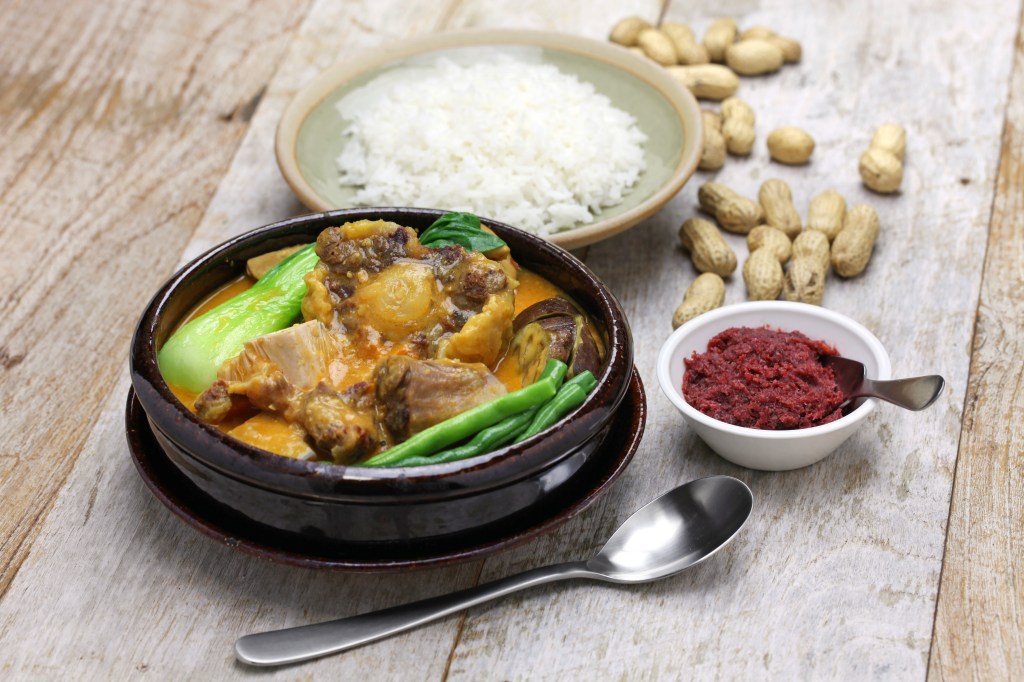
Comfort in a Clay Pot
There are dishes that go beyond flavor—dishes that feel like a hug, a memory, a story retold at every table. For Filipinos, Kare-Kare is that dish. A golden peanut stew thickened with patience and tradition, served with bagoong (fermented shrimp paste) on the side, Kare-Kare isn’t just eaten—it’s celebrated.
Born in Pampanga, the culinary heart of the Philippines, Kare-Kare has long been tied to fiesta tables and family gatherings. Its origins whisper of history—some say it traces back to Moro culinary traditions, others to the influence of Spanish colonizers. What’s certain is this: Kare-Kare is Filipino comfort food at its most soulful.
A true Kare-Kare is rich but never rushed. Oxtail, beef tripe, or short ribs are slowly simmered until tender. Toasted rice flour thickens the sauce, while ground roasted peanuts create the dish’s signature nutty depth. Alongside the meat, banana blossoms, string beans, and eggplant soak up the stew like sponges of flavor.
But Kare-Kare is never complete without bagoong. The salty, funky shrimp paste is the contrast that makes the dish sing—comfort balanced with boldness.
Recipe: Authentic Filipino Kare-Kare
Servings: 6
Prep Time: 30 minutes
Cook Time: 2 hours
Ingredients:
- 1 kg oxtail (or mix with beef shank/short ribs)
- 2 tbsp cooking oil
- 1 onion, chopped
- 5 cloves garlic, minced
- ½ cup ground roasted peanuts (unsalted)
- 3 tbsp toasted rice flour (brown rice flour works too)
- 4 cups beef stock
- 2 tbsp annatto seeds (soaked in ¼ cup hot water, strained)
- 1 banana blossom (sliced)
- 1 eggplant, cut into chunks
- 200 g string beans, cut into 2-inch pieces
- 1 bunch bok choy or pechay
- ½ cup bagoong (shrimp paste), sautéed
Instructions:
- In a large pot, boil the oxtail until tender (about 1.5–2 hours). Reserve stock.
- In another pot, heat oil, sauté onion and garlic until fragrant.
- Stir in annatto water for color, then add peanuts and rice flour to create a thick paste.
- Slowly whisk in beef stock until smooth and creamy.
- Add the tender oxtail and simmer for 15 minutes.
- Stir in vegetables, cooking until just tender (beans and bok choy last so they stay crisp).
- Serve hot, with bagoong on the side.
Kare-Kare is not just a recipe. It’s a lesson in patience, a reminder that comfort comes from layering time, care, and contrast. In a world rushing toward speed and efficiency, Kare-Kare asks us to slow down—because good things, soulful things, take time.
To cook this dish is to practice memory. To eat it is to belong—to family, to community, to culture. That is why Kare-Kare is not only Filipino comfort food—it’s a lifestyle story in a clay pot.
What’s your comfort dish—the one you can’t forget, the one that feels like home? Share it with us on Threads or Instagram with #FoodMeetsLifestyle.
